Monday, February 15, 2016
Friday, February 12, 2016
What are Gravitational Waves?
Today, the National Science Foundation (NSF) announced the detection of gravitational waves by the Laser Interferometer Gravitational-Wave Observatory (LIGO), a pair of ground-based observatories. But…what are gravitational waves?
Let us explain:

Gravitational waves are disturbances in space-time, the very fabric of the universe, that travel at the speed of light. The waves are emitted by any mass that is changing speed or direction. The simplest example is a binary system, where a pair of stars or compact objects (like black holes) orbit their common center of mass.

We can think of gravitational effects as curvatures in space-time. Earth’s gravity is constant and produces a static curve in space-time. A gravitational wave is a curvature that moves through space-time much like a water wave moves across the surface of a lake. It is generated only when masses are speeding up, slowing down or changing direction.
Did you know Earth also gives off gravitational waves? Earth orbits the sun, which means its direction is always changing, so it does generate gravitational waves, although extremely weak and faint.
What do we learn from these waves?
Observing gravitational waves would be a huge step forward in our understanding of the evolution of the universe, and how large-scale structures, like galaxies and galaxy clusters, are formed.
Gravitational waves can travel across the universe without being impeded by intervening dust and gas. These waves could also provide information about massive objects, such as black holes, that do not themselves emit light and would be undetectable with traditional telescopes.

Just as we need both ground-based and space-based optical telescopes, we need both kinds of gravitational wave observatories to study different wavelengths. Each type compliments the other.
Ground-based: For optical telescopes, Earth’s atmosphere prevents some wavelengths from reaching the ground and distorts the light that does.
Space-based: Telescopes in space have a clear, steady view. That said, telescopes on the ground can be much larger than anything ever launched into space, so they can capture more light from faint objects.
How does this relate to Einstein’s theory of relativity?
The direct detection of gravitational waves is the last major prediction of Einstein’s theory to be proven. Direct detection of these waves will allow scientists to test specific predictions of the theory under conditions that have not been observed to date, such as in very strong gravitational fields.

In everyday language, “theory” means something different than it does to scientists. For scientists, the word refers to a system of ideas that explains observations and experimental results through independent general principles. Isaac Newton’s theory of gravity has limitations we can measure by, say, long-term observations of the motion of the planet Mercury. Einstein’s relativity theory explains these and other measurements. We recognize that Newton’s theory is incomplete when we make sufficiently sensitive measurements. This is likely also true for relativity, and gravitational waves may help us understand where it becomes incomplete.
Thursday, February 11, 2016
GALILEO – ΒULLET / MISSILE THEORY
*** GALILEO – ΒULLET / MISSILE THEORY - NEWTON : if you shoot (horizontally and straight to the target) with a gun G3 kneeling or lying a target at 300 meters, given that the bullet runs with 800 m / sec , at 1/3 sec the bullet goes to the center of the target and it has not gone down (having a greater range). (I've done it personally hitting the center of the target with 10 continious bullets). If you leave it from the same small height it takes again 1/3 sec the most to reach the ground. (The same happens to a space without air -air resistance- , except that there the target must be put a little farther or a little closer than 300 meters since the speed changes a little). Thus the Galileo proposal that a body that is pushed horizontally will fall to the ground at the same time with a body that is vertically left to fall at the same time from the same height , is not exactly correct but it is quite statistic and has to do with a rather weak push. Further on the basis of Galileo – Newton , in the fall of bodies, the vertical distance is proportional (analogic) to the square of the time since Galileo let objects to fall to the ground from a ski slope : when the body left the ski slope it traveled a horizontal distance (the shadow of which in the ground is the time of the drop) , and also it traveled a vertical distance (which is the distance between the edge of the ski slope and the ground) and this distance is the space of the fall. However , if we select a different – bigger ski slope with much larger vertical length (in the same distance from the ground as before) we shall see that the horizontal vector-time-shadow will be bigger than before because the body in the ski slope has taken much more speed than before. So the analogy is rather ruined. Therefore we see that the physics of proposals (calculus Principia propositions) of Galileo - Newton (F = G mM / r2 , etc.) is a good and reasonable statistical technical approach that weakens in bigger conditions. THE TRUE MAN IS THE MEASURE OF ALL FLUID THINGS.
*** ΑΒΟUT THE ACCELERATION ¨ further , simply put , Galileo's acceleration a =S/t2 means that '' a body moves with eg 4 m/1sec2 '' (ie 1 sec squared). This means that '' the body in 1 sec is moving at 4 m/sec '' or that '' in the end of 1 sec the body covers 4 m in 1 sec i.e. 0,4 min 0,1 sec as momentum speed''. However (since as we said if we choose another Galileo ski slope the Galileo square analogy in time would not be exactly correct) -since the momentum ιnstantaneous speed is fluid , it could be said that : '' at the end of 1 sec the body covers 0 ,4 m in 0.1 sec at the end of which 0.1 sec the body covers 0,04 m in 0,01 sec '' and the acceleration could be defined as a =S/t3 ie 4m/1sec3 (ie sec cubed and not squared). Thus other equations should also be changed. Eg the equation of Galileo for the ''average speed' of an accelerated body S =(1/2)at2 has to do not only with the acceleration of gravity ''G = 9,8 m / sec2'' but also with any other acceleration even larger , so it also could be cubed instead of squared. (Even if we accept the Galileo square , the truth is that a falling accelarating body does not easily accept a definition of a stable ''average speed'' 5m / sec , because if in the first sec it has traveled 5 m, in the 2nd sec it will have traveled much greater distance , for example at least 20 m. And if we put the cube in the acceleration equation it would be even bigger with obvious consequences in the Newtonian ''F = GmM/r2''. So we are talking about rather fluid and calculus type equations that do not involve much wider and bigger conditions.
Trully if you accept ''average speed'' 5m/sec = in 1 sec 5 m , you cannot easilly accept ''average speed'' 20m/2 sec=10m/sec=in 1 sec 10 m , so it is all statistic and fluid.
-------------------------------------------------------------------------------------------------------------------------------------------------
In this post i mean 9,8 = g and not G
-------------------------------------------------------------------------------------------------------------------------------------------------
Wednesday, February 10, 2016
On the deceleration or acceleration
Further, in simple terms under acceleration a galilean =s / T2 means '' A body moving bc with 4 M / 1 Sec2 '' (i.e. 1 Sec Squared). That means '' The body in 1 SEC IS MOVING AT 4 M / SEC '' So how '' At the end of a sec body cover 4 M IN 1 sec i.e. 0,4 m in 0,1 sec ''. However (since like we said, if you choose more galilaiikḗ slide would be undermined as a statistical the proportion of the block) Here-because the instant speed is fluid concept-could have said this: '' At the end of a sec body cover 0,4 m in 0,1 sec at the end of which 0,1 sec body cover 0,04 m in 0,01 SEC '' And Set the acceleration as a =s / t3 i.e. 4 M / sec sec3 (i.e. in the cube-and not on the block). It should be amended and other similar types. Bc the-Average-type of Galileo for '' Average speed '' A body of accelerating χ=(at2 1/2) not only for the acceleration of gravity '' G = 9,8 m / sec2 '' But every other acceleration however big, so I'll epidécheto and power in the cube instead of power on the block. (besides-even if we accept the block of Galileo-a falling body accelerating cannot be easily definition fixed medium speed bc steady speed on average 5 M / sec, because if the first sec has comes 5 M, in 2 O sec will have travelled far greater distance bc at least 20 m. If we put cube the acceleration would be even greater with obvious consequences in Newton '' F=Gmm / R2 ''. Basically it is a largely types these weekly meetings, autoanaphorikoús, by way of trigon not relating to much broader conditions.
*** ΑΒΟUT THE ACCELERATION AND GALILEO : further , simply put , Galileo's acceleration a =S/t2 means that '' a body moves with eg 4 m/1sec2 '' (ie 1 sec squared). This means that '' the body in 1 sec is moving at 4 m/sec '' or that '' in the end of 1 sec the body covers 4 m in 1 sec i.e. 0,4 m in 0,1 sec as momentum speed''. However (since as we said if we choose another Galileo ski slope the Galileo square analogy in time would not be exactly correct) -since the momentum ιnstantaneous speed is fluid , it could be said that : '' at the end of 1 sec the body covers 0 ,4 m in 0.1 sec at the end of which 0.1 sec the body covers 0,04 m in 0,01 sec '' and the acceleration could be defined as a =S/t3 ie 4m/1sec3 (ie sec cubed and not squared). Thus other equations should also be changed. Eg the equation of Galileo for the ''average speed' of an accelerated body X =(1/2)at2 has to do not only with the acceleration of gravity ''G = 9,8 m / sec2'' but also with any other acceleration even larger , so it also could be cubed instead of squared. (Even if we accept the Galileo square , the truth is that a falling accelarating body does not easily accept a definition of a stable ''average speed'' 5m / sec , because if in the first sec it has traveled 5 m, in the 2nd sec it will have traveled much greater distance , for example at least 20 m. And if we put the cube in the acceleration equation it would be even bigger with obvious consequences in the Newtonian ''F = GmM/r2''. So we are talking about rather fluid and calculus type equations that do not involve much wider and bigger conditions.
Trully if you accept ''average speed'' 5m/sec = in 1 sec 5 m , you cannot easilly accept ''average speed'' 20m/2 sec=10m/sec=in 1 sec 10 m , so it is all statistic and fluid.
The most famous guy for straight smooth movement is the u =S / T. The guy who gave himself Galileo to express the average speed of an accelerated college is x = (1/2) a t2, whom I have. As I mentioned the guy under the galilean concerns expression of the average speed of an accelerated college and no rectilinear smooth movement (U= s / T) neither of the acceleration (a =S / T2). If in a mean in acceleration put the g so the acceleration due to gravity 9,8 m / sec2, we get 5 M IN 1 SEC AND 20 M IN 2 sec so we have an expression of the average speed for A falling body as follows: average speed of 5 M IN 1 sec and average speed of 20 metres in 2 sec and average speed of 45 M IN 3 SEC, etc.
Thursday, February 4, 2016
Monday, February 1, 2016
10 Facts About Black Holes You Didn’t Know
A black hole is a region of space time with a very strong gravitational force that even the light cannot escape from the inside of a black hole. Black hole can as big as millions of sun together or as small as a atom. Here is a list of 10 crazy facts about black holes.
1. Black holes decide the number of stars in the galaxies

Some scientists believe, the number of stars in the universe are limited by the number of black holes in our universe.
2. Laws of physics don’t work at the center of a black hole

According to some theories, a black hole is crush matter to infinite density. When this happens, the laws of physics break down because it is not possible to conceive of anything with a zero volume & infinite density.
3. Any matter like Iron can become a black hole

Most people believe that stars are the only things that can convert into black holes. If your car were shrunk down to a infinite small point and still able to retained all of their mass, Its density would reach tremendous levels which would make its force of gravity strong enough to become a black hole.
4. Dense

To pull light into itself a black hole should have enough gravity. Black hole has to contain a enormous amount of mass in a small space.
5. Albert Einstein did’t discovered the black holes

Albert Einstein only revived a theory about black holes in 1916. In 1783, John Mitchell was the one who developed the theory after he wondered if its possible that a gravitational force could be so strong that even particles of light couldn’t escape from it.
6. Different kinds of black holes

Modern astronomers and scientists believe that black holes come in different types. There are spinning black holes and electrical black holes and also the spinning electrical black holes.
7. You’ll be killed in horrible way near a black hole

Although it obvious that a black hole will probably kill you, most people think they would just get crushed by the black hole. But that isn’t true, your body would most likely get stretched to death.
8. Black holes do spin

When collapses of the core of a star happens, the star start rotating faster and faster and also becomes smaller and smaller. But then it reaches the point where it doesn’t have much amount mass to convert into a black hole, it gets squeezed together and form a neutron star and also continues to spin rapidly. Same thing applies to black holes.
9. Massive black hole at the center of the Milky Way galaxy

The one in the center of the Milky Way is one of the biggest discovered yet. It’s 30,000 light years away from us and is more than 30 million times massive than our sun.
10. Black hole near to the Earth

The nearest black hole to our earth is 1,600 light years away.
Wednesday, January 27, 2016
10 Crazy Facts You Didn’t Know About The Sun
We see it every day and its probably one of the most important and necessary thing needed for the existence of life. But how much do we actually know about Sun? Ok, so you probably know at least a few things, but not the things we are going to tell you right now.
1. Nuclear Bombs
 Every second the sun gives off the same amount of energy as 10 billion nuclear bombs. To just give you a hint, only few hundred of nuclear bomb is enough to destroy our whole world. Nuclear weapons are more powerful now than they were in the time of second world war.
2. Less than 30 days

All the energy used by man since the dawn of civilization is roughly equal to 30 days of the sun’s energy. Yupe that’s all it is for the Sun.
3. A lot of power
 Every year our planet Earth absorbs 94 billion megawatts of energy from the sun. That’s more than the world’s total energy need.
4. Green flash
 We all know that the sun can be yellow or orange but did you know that it can be green also? This phenomenon is known as green flash is very rare.
5. 1 million years

6. It is heavy
 Well, it’s massive, it is really huge check out the picture above. In fact, it accounts about 99% of the mass of the entire solar system and all the other planets and star or anything in our solar system is just 1% of our total solar system mass.
7. It’s not yellow
 Most photos captured and what we see suggests that the sun orange, red, yellow or a combination of the three. But in reality, the sun none of them it is white. It appears yellow to us because of the blue light present in the Earth’s atmosphere.
8. The Sun can make us taller
 When the sun and moon are in a apogee, or pulling the Earth in the same direction, our bodies get stretched but only microscopically.
9. It was a monster
 At least that’s what people used to think back in the days. One legend said it was a man with 3 eyes and 4 arms that he was abandoned by his spouse for being too bright and shine.
10. It’s really bright
 Ok, so you knew that sun is really bright, but did you know that it is brighter than about 85% of everything else in the entire Milky Way?
Tuesday, January 19, 2016
White Holes: The Other Side of Black Holes
 |
| Courtesy: JPL NASA |
I was watching the documentary Master of the Universe, by Stephen Hawking, and I remembered my own ideas of who we are and where we come from. Although my ideas have some basis in currently accepted scientific theories, they are still mostly imagination, and I can’t provide any mathematical or physical proof for them. Enjoy the imagination, and build upon it if you wish to.
String theory states that all particles are nothing but different vibrating strings of matter. A string is to an atom roughly as a human is to our known universe in size. It reminds me of the words nad Brahma, from India’s ancient past, which means that sound (waves) is the creator. This is pretty close to what the string theory theorizes now.
Scientists struggle to combine Einstein’s theory of relativity with string theory. Einstein’s theory of relativity explains how things work at large, and String theory explains how they work on the quantum level. But when we try and combine these two, they seem to not work together. The rules of physics seem to break down, especially in case of singularities, also known as black holes.
 |
| Andrew J. Hanson, Indiana University. [CC-BY-SA-3.0 or Attribution], via Wikimedia Commons - See more at: http://www.blueplanetjournal.com/cosmos/white-holes-the-other-side-of-black-holes.html#sthash.od8bmg2v.dpuf |
The answer to that question will require some creative thinking. Let’s go to our Big Bang event. As Stephen Hawking explains, our Big Bang was nothing but an eruption of a big black hole and all the fundamental forces were combined in one super force before the eruption. The question arises: Why did it happen, and why here and not somewhere else? Why only four kinds of fundamental forces? Why not three or five or any other arbitrary number?
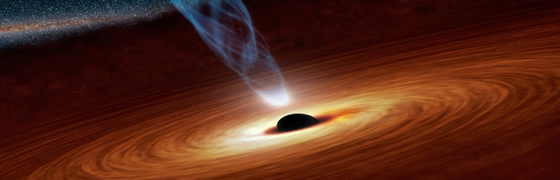
The more I think about it, the more I get imaginative. Let’s go back to the concept of the black hole for our answers. A black hole is a collapsed star with such enormous gravitational force, even light cannot escape.
 |
| Courtesy: JPL NASA |
To understand a black hole, think of a star as you sitting on a bed, and when you put a ball near you it tries to roll in the hole created by your weight. On a larger scale, that hole you created is called the warping of space. The gravity of massive objects warp our three dimensional space, and when some other object comes close to that heavenly body, it falls in that warp and starts moving towards it in a slow circular motion. It takes billions or even trillions of years for both of them to fall into each other.
Sun, our star
To understand a black hole, I will give another example. A star is massive and has lots of matter; it has immense gravity, but the matter is still intact. A hydrogen atom is still hydrogen atom. A star stays in its form by a critical balance of the energies which are forcing it outward and inward. Gravity tries to pull everything inwards. When a large star burns up its fuel, gravity starts getting an edge over other energies pulling the star outwards. And, when gravity wins, the star collapses, and becomes a black hole.
Let’s imagine our space as a thin paper sheet which can hold the weight of a few empty cardboard boxes, which represent matter. If we have a bunch of them and we put them spread out over that thin paper floor, it might be able to hold their weight if it’s equally distributed on the whole floor. It will warp the floor, but still won’t break it. But, if we take out all the space from the cardboard boxes by flattening them and combining them in one stack, what happens? The floor collapses. It breaks down, and that’s precisely what happens when a star collapses onto itself. All that matter which was occupying a large space in our space tries to fit in a very small space because atoms break down to particles and possibly even further, and space is not able to hold so much mass in some very small space. At a critical point it creates a hole in our space-- a black hole is born. Its gravity starts pulling matter around it and starts compressing it, as it did to itself.
But does that mean the matter which goes in a black hole disappears? I think that’s not the case. What happens in a black hole is that it crushes the matter and takes out all the extra space between the molecules and strings, or even beyond the strings if we come to know that level of smallness in the future.
All that condensed matter goes to other dimensions.
Now, let me expand a little about matter appearing in our dimension from other dimensions. We know now that our space, which we thought was empty, is not really empty, but is full of matter which has significant mass which is not visible to us yet. There are particles which appear in space randomly, containing positive mass and negative mass, and they annihilate each other when they meet each other. Small particles can do that because our dimension has small pockets of empty space, but enormous mass from other dimension cannot erupt into ours because our space is teaming with particles and mass, and doesn’t have a weak spot for so much matter to erupt.
life of a photon
What will happen in a few trillion or quadrillion years to our universe? We know that the universe is expanding; everything in our universe is running away from each other at a great speed. In some trillion or more years, we will have huge gaps between galaxies, and in some distant future, perhaps the density of mass in our universe will become so thin that it won’t be able to stop mass from other dimensions from erupting into our own. The weakest pocket in this space will be the point where the new big bang will happen-- the same as how our Big Bang happened. And, that will be the beginning of a new universe with its own physical properties and rules, depending on how the eruption occurs and matter breaks down in strings again. Different sized strings will create different kinds of particles and different sets of everything we know. We might see more or less than the four fundamental forces which we see in our universe.
We can call these eruptions a white hole or a Big Bang. Contrary to the black hole, a white hole is where matter comes out from and gets uncondensed, finding suitable conditions and available space. Matter comes out with so much force that the eruption creates a bubble around it which becomes a new universe with its own big bang.
Since string size is arbitrary and infinite in number as well as particles, it’s very difficult but still possible to have the same set of rules as our universe in one of these eruptions somewhere in space. We can find universes which are governed by the same rules as ours, or at least quite similar. There can be universes which are microscopic compared to our own, or so vast that our universe looks microscopic in front of them, depending on the size of the white hole from which it was born.
Another phrase from ancient India is jeevan chakra, which means the circle of life. Life is cyclical, just like our universe, exploding and imploding in black and white holes, coming to life and death on its own again and again. The finer energies will keep playing the game of life forever, and this circle will go on…
Friday, January 8, 2016
Natural Ways For Cleaning Your Lungs of Nicotine And Tar
 |
| smoker's and non-smoker's lungs |
No matter how aware people are of the harmful ingredients in cigarettes and how they are the number 1 cause of lung cancer, they still can’t quit smoking. Well if you recognize yourself in the sentence above, the least you can do is clean your lungs of nicotine and tar build up and decrease your risk of infections.
There’s no magical formula that will cleanse the lungs instantly, but here is a list of foods that works best at throwing out the nicotine and tar.Corn is a food that contains beta-cryptoxanthin, which is believed that can protect you from lung cancer, because it is a powerful antioxidant. However, consume only organic, fresh corn.
Selenium is a very powerful antioxidant. Brazil nuts contain the highest source of selenium compared to other foods, so eat it as much as possible.
Onion is also a good lung cleaner. Onions can be of great help to prevent many diseases, including lung infections. In the case of people who already have cancer, it prevents the growth of new cells.
Ginger as a natural medicine and food, helps to defend against malignant diseases. This is another strong tool to relive you from the toxins in your lungs. You can consume ginger root tea, because it facilitates breathing. Also, you can eat a piece of ginger with a meal.
Oranges contain cryptoxanthin, which has a preventive effect against lung cancer.
Nettle is a plant full of iron, but it is very useful as a mean of disinfection for the lungs and plays an important role in fighting infections.
Pine needles tea is traditionally used for rinsing the mouth and throat, but can also be a good ally in the fight against lung cancer.
Subscribe to:
Posts (Atom)